I have sat in enough procurement meetings in East Africa to know when sustainability language is actually doing work, and when it’s just … language. Most of the time, it’s the latter. Not because people are dishonest, but because the frameworks they’re borrowing were designed for supply chains that look nothing like what we’re actually running here.
Supply chain sustainability in Africa is not a communication problem. It is an infrastructure problem, a financing problem, and a standards problem, often all three at once.
If you want to understand what genuine progress looks like on this continent, you have to start by being honest about what the baseline actually is.
The emissions picture nobody talks about clearly
The global numbers on supply chain emissions are stark. According to BCG and CDP research from 2024, Scope 3 supply chain emissions were 26 times greater than direct operational emissions in 2023. McKinsey puts it at roughly 80 to 90% of most companies' total climate impact sitting in the value chain, not in direct operations.
Let me translate that: most companies have been measuring and reporting a fraction of their actual emissions.
In Africa, that problem has an additional layer. The data to measure baseline emissions across most supply chains simply does not exist at the granularity a credible decarbonisation plan requires. You cannot reduce what you cannot measure. Most mid-tier logistics and procurement operations on the continent are not yet positioned to generate the Scope 3 data that global frameworks demand.
That gap is not a moral failing. It is a resource and capacity gap. It has to be treated as such if the sustainability push is going to mean anything practical.
The Northern Corridor is a useful window into what African freight emissions actually look like at scale. This is the multimodal route linking Uganda, Rwanda, Burundi, and South Sudan to the port of Mombasa.
UNEP's analysis of the corridor shows up to 3,000 trucks daily on the route, with air pollution alone linked to 1.1 million deaths annually across the region. More broadly, transport accounts for roughly 10% of Africa's total greenhouse gas emissions, a share that is growing as freight volumes expand with economic development.
Africa is also responsible for a fraction of global historical emissions while absorbing a disproportionate share of the consequences. That is not a reason to defer action. It is a reason to be clear-eyed about where the financing obligation sits.
Food loss is a supply chain problem
If you want to understand the carbon and economic cost of Africa’s supply chains in concrete terms, start with food.
According to the Green Climate Fund’s Re-Gain programme, Africa loses between 30% and 50% of food produced before it reaches consumers, usually due to inadequate storage, poor roads, and a near-complete absence of cold chain capacity outside major urban areas. The FAO estimates that 37% of food in sub-Saharan Africa is lost between production and consumption.
Here’s what I’ve come to learn while in the corridors of procurement: the food loss problem and the supply chain problem are the same thing.
The value destruction involved is staggering. Africa imported nearly $100 billion in food in 2023, while simultaneously watching tens of billions of dollars’ worth of domestically grown produce spoil before it could reach a buyer.

A farmer in Kaduna with 8 tonnes of tomatoes and no processing facility within reach will lose most of that harvest to spoilage. A farmer in rural Kenya with no access to temperature-controlled transport faces the same equation. Only 15% of Kenyan smallholder farmers can currently access cold chain facilities, largely because the transport costs alone make it inaccessible.
Post-harvest losses are not just a food security tragedy, but an emissions story that rarely gets told in those terms. Every tonne of produce grown, transported, and then lost represents wasted agricultural inputs, water, land, and fuel, all of which generated emissions with no productive output at the end of the chain. The food loss problem and the emissions problem are the same problem wearing different labels.
There are working models. AgroMall in Nigeria demonstrated that pairing digital aggregation with physical infrastructure, actual warehouses, trucks, and processing hubs, can bring post-harvest losses down from 50% to 15% while cutting logistics costs by 40%. The catch is that this model requires patient capital on 5-to-7-year infrastructure timelines.
African agritech has historically attracted capital into digital platforms with shorter proof-of-concept cycles, while the physical infrastructure that would actually move the needle on food loss goes chronically underfunded.
The compliance problem nobody wants to name directly
Let’s name an uncomfortable truth. Most ethical sourcing standards were designed by buyers in high-income markets, for supply chains that bear very little resemblance to what actually operates across sub-Saharan Africa.
Take the EU Deforestation Regulation, which requires exporters of coffee, cocoa, and other commodities to demonstrate their produce was not grown on deforested land after 2020. For a large Kenyan exporter with a formal, documented supply chain, this is an administrative challenge.
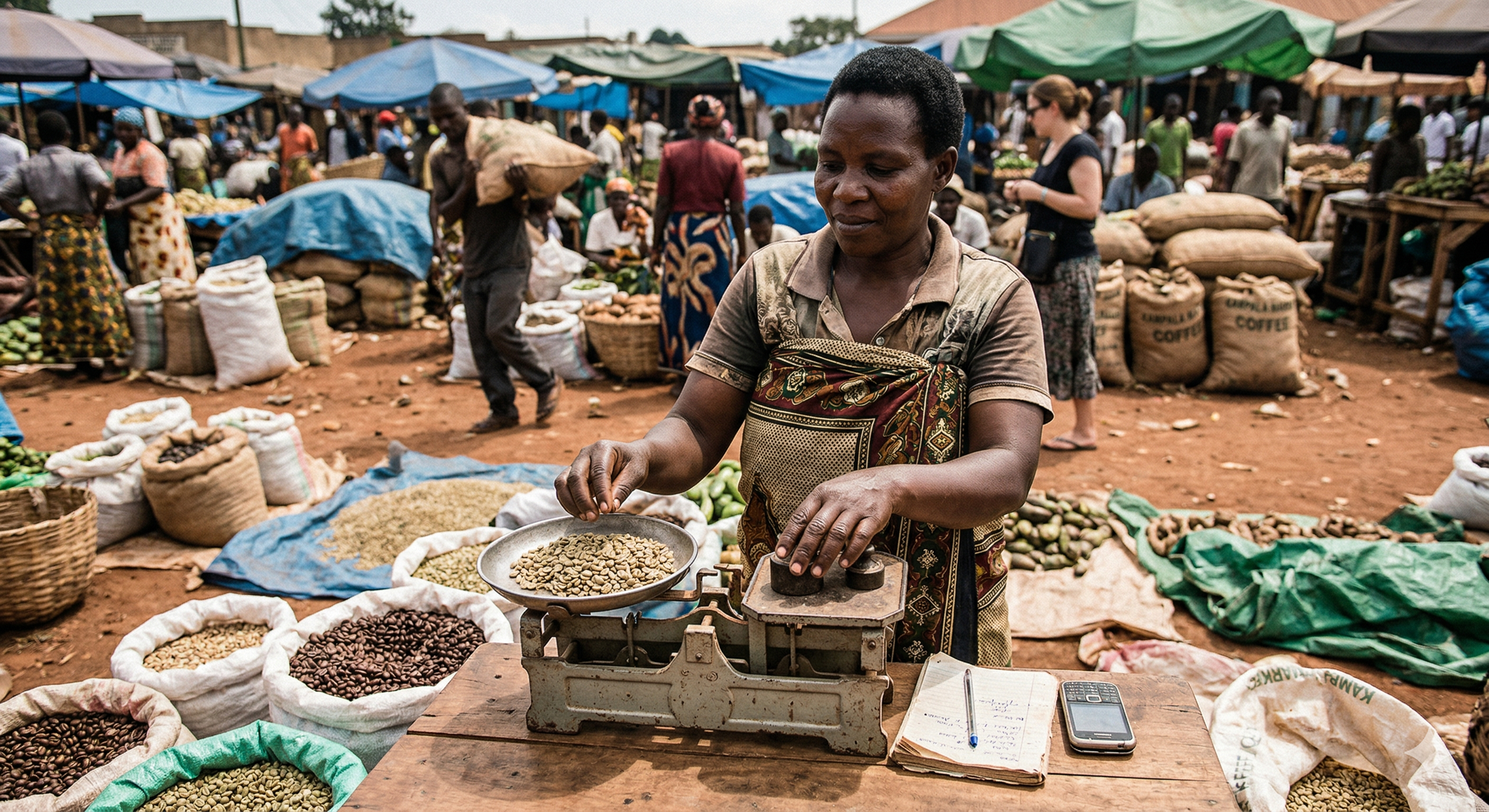
For a smallholder coffee farmer aggregating through informal channels, with no formal land title and no system for documenting farm boundaries against a satellite imagery baseline, it is potentially a market exclusion event.
A World Bank panel at COP28 was unusually direct about this, noting that small and medium-sized exporters in developing countries risk being excluded from global value chains by compliance requirements they lack the capacity and resources to meet. The recommended response was that advanced economies should harmonise their standards and provide technical support for developing-country compliance, rather than using sustainability standards as a barrier that effectively concentrates market access among larger formal producers. That recommendation has not been acted on with urgency.
From where I sat in procurement, this tension has a very practical face. When you are sourcing from informal suppliers in Kenya's agricultural supply chains, you are often choosing between demanding documentation that suppliers cannot produce or continuing to source from them and accepting that your sustainability reporting will have gaps. Neither option fits cleanly into the sustainability frameworks designed for supply chains with fully documented tier-one through tier-three supplier networks.
The frameworks are not wrong in aspiration. They are just built for a different operating context.
Last-mile delivery and what efficiency actually requires
Kenya's e-commerce growth is real and accelerating, and with it, the pressure on urban last-mile logistics. The environmental cost of last-mile delivery is disproportionate relative to the distances involved: short trips, heavy stop-start traffic, largely petrol or diesel-powered motorcycles and light trucks, concentrated in city centres where air quality is already under strain.
Electric boda bodas and tuk-tuks are already making inroads here, and the case is not purely environmental. Lower running costs on electric two-wheelers meaningfully reduce per-kilometre delivery costs on high-frequency urban routes, which matters for sole-proprietor delivery operators who are already working on thin margins.
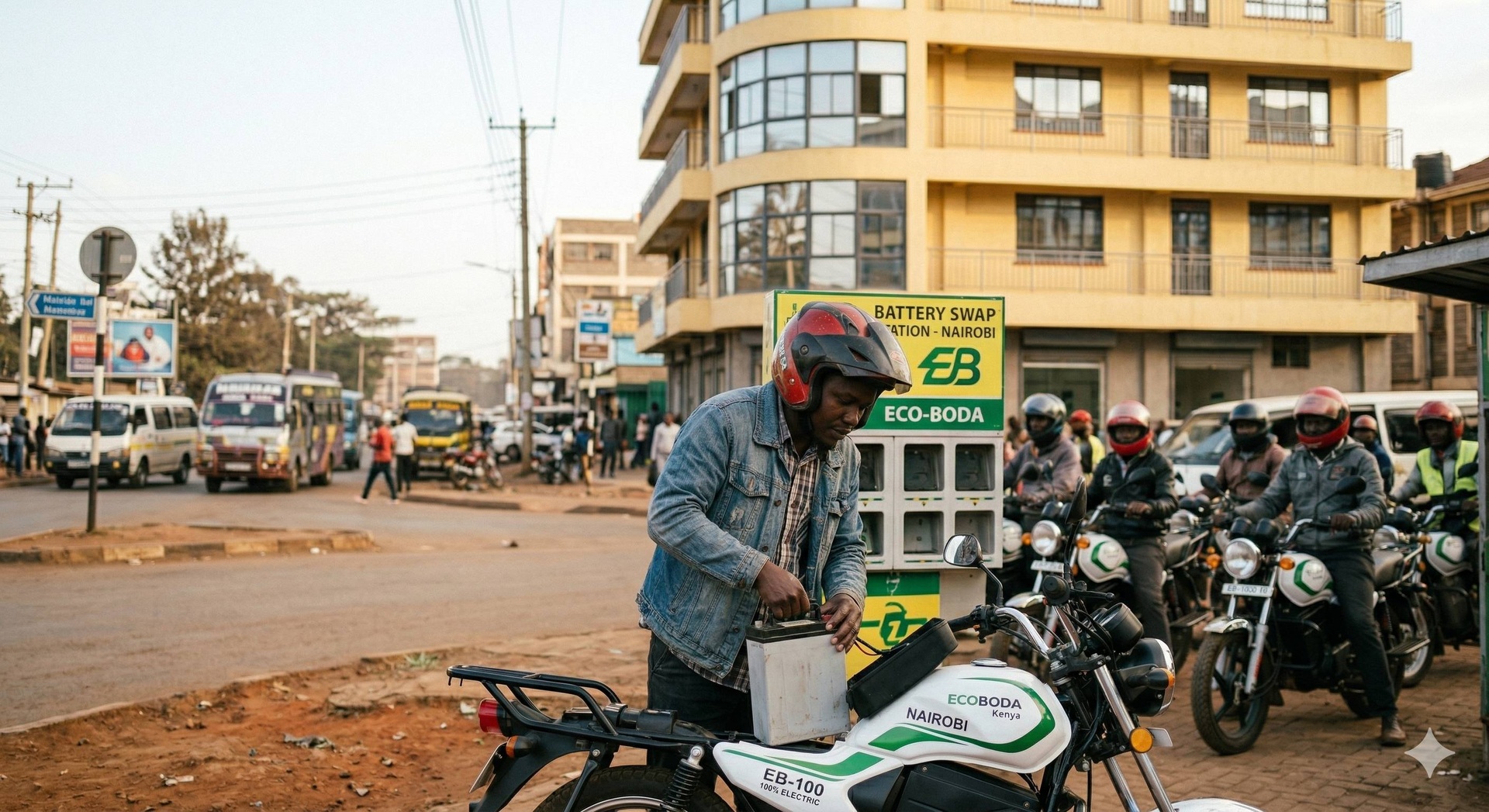
Battery-swapping infrastructure, which sidesteps the charging time problem entirely, can be deployed in urban areas without requiring grid upgrades.
The persistent barrier is not the technology, but access to financing. Most last-mile delivery operators in Kenya are individuals or small cooperatives, not corporate fleets with ESG mandates and green finance relationships. Getting an electric motorcycle into the hands of a boda boda operator who runs 8 to 10 deliveries a day requires microfinance structures, pay-as-you-ride models, and leasing schemes at a scale that simply does not yet exist across the sector.
Before any vehicle electrification happens at all, fleet management systems, route optimization, and digital procurement tools reduce fuel consumption and empty mileage on operating fleets today.
I have seen route optimization alone produce meaningful fuel cost reductions on active heavy vehicle fleets. These tools do not require new vehicles or grid infrastructure. They require data, good systems, and the discipline to use them consistently. For operators who cannot yet afford the capital outlay on new electric assets, this is where the accessible sustainability gains sit.
What frameworks that actually work look like
The sustainability approaches that hold up in African supply chain conditions tend to share certain qualities. They are honest about the infrastructure baseline rather than assuming it into existence. They treat the informal sector not as a problem to be formalized but as a structural feature of how commerce actually works across most of the continent. They count food loss and cold chain investment as sustainability priorities alongside carbon accounting. And they distribute the cost of compliance in ways that do not systematically disadvantage the smallest and most marginalized producers.
The African Continental Free Trade Area creates a real opportunity here. If AfCFTA's integration deepens, it gives Africa a chance to develop regional sustainability standards calibrated to African operating conditions, rather than importing European regulatory frameworks wholesale into contexts they were never designed for.
Regional standards that account for infrastructure gaps, informal supply chain structures, and the development stage of most African economies would be more enforceable, more equitable, and ultimately more effective than compliance regimes designed for supply chains that look nothing like what actually moves goods across this continent.
The stakes here are not abstract. As UNEP’s 2024 Emissions Gap Report shows, global emissions hit a record 57.1 gigatons in 2023. The trajectory is still wrong.
Africa’s logistics operators are not the primary authors of that number. But they are among the first in line to feel the consequences: disrupted agricultural seasons, more extreme weather, worsening food insecurity.
Supply chain sustainability on this continent is not a reporting obligation. It’s a resilience imperative. The frameworks, financing, and standards should be built with that in mind.