When you’ve managed a heavy commercial fleet in Kenya, you don’t read EV news the way a policymaker or a journalist does. You read it twice.
First to catch the headline. Then again, pencil in hand, to figure out whether any of it actually works for a heavy-duty truck on a remote site.
I managed over 90 vehicles and heavy machinery across active industrial sites in Nairobi, Kenya’s capital. Concrete trucks, semi-trailers, excavators, wheel loaders, boom pumps, site dumpers. Machines running long shifts on remote sites where the nearest town was an hour away, and when something broke, you were immediately managing a project delay, a client call, and a parts search all at once.
That is the operating context I bring to the Africa EV conversation. The ambition is real and commendable, to say the least. However, the gaps are just as real. And most of the serious work lies in the distance between them.
On paper, Kenya’s EV numbers look great. But not quite once you scratch the surface.
Kenya has genuine momentum on EVs. According to Kenya's Ministry of Roads and Transport, cumulative EV registrations in the country reached 39,324 by early 2025, up from 1,378 in 2022. That is a dramatic jump in three years, and it is not by accident.
The government zeroed VAT on electric buses, motorcycles, and lithium-ion batteries under the Finance Bill 2025, and BasiGo, Nairobi's homegrown electric bus company, has since assembled over 100 buses locally with a stated target of 1,000 on the road by 2027.
But zoom out, and the picture gets more complicated. The IEA's Global EV Outlook 2025 records that electric car sales across Africa more than doubled in 2024, reaching nearly 11,000 units for the year. That is growth worth celebrating. It is also less than 1% of total car sales on the continent.
Meanwhile, China runs around one in ten cars on electricity. Europe's sales share, on the other hand, sits at roughly 20%. Africa's EV market is not nascent because Africans are uninterested in cleaner vehicles, but because the infrastructure, the financing, and the policy conditions that would make adoption viable at scale simply do not yet exist across most of the continent.
The Energy for Growth Hub's Africa EV Readiness Index is direct about this. Of 48 African countries assessed, only 8 meet high grid reliability standards. Most would need to redirect more than a fifth of their projected ten-year electricity demand growth just to support converting 30% of road transport to EVs.
Africa's average motorisation rate sits at 73 vehicles per 1,000 people, compared to over 500 per 1,000 in most high-income economies. Low uptake, in other words, is not a technology story but rather an income story.
That’s the macro view. Here’s what it means for someone managing the fleet.
Road transport accounts for more than 40% of Kenya's total energy consumption and is the country's fastest-growing source of emissions, according to the Energy and Petroleum Regulatory Authority. Kenya spends over $5 billion annually on fuel imports, which means every serious commercial operator has felt the exposure to global oil price movements. You feel it in your fuel budget every quarter, sometimes every month.
The challenge with transitioning heavy commercial fleets is not philosophical. It is operational. When I think about electrifying the kind of fleet I managed, the first question is never about emissions, but about range, reliability, and what happens when something goes wrong 30 kilometres from the nearest technician who has ever seen the inside of a lithium battery management system.
Something else, range anxiety for a private car is a mild inconvenience. But range anxiety for a concrete truck on a pour schedule? Or a boom pump on a site where the contractor is counting down to a critical pour window? That's a commercial disaster brewing.
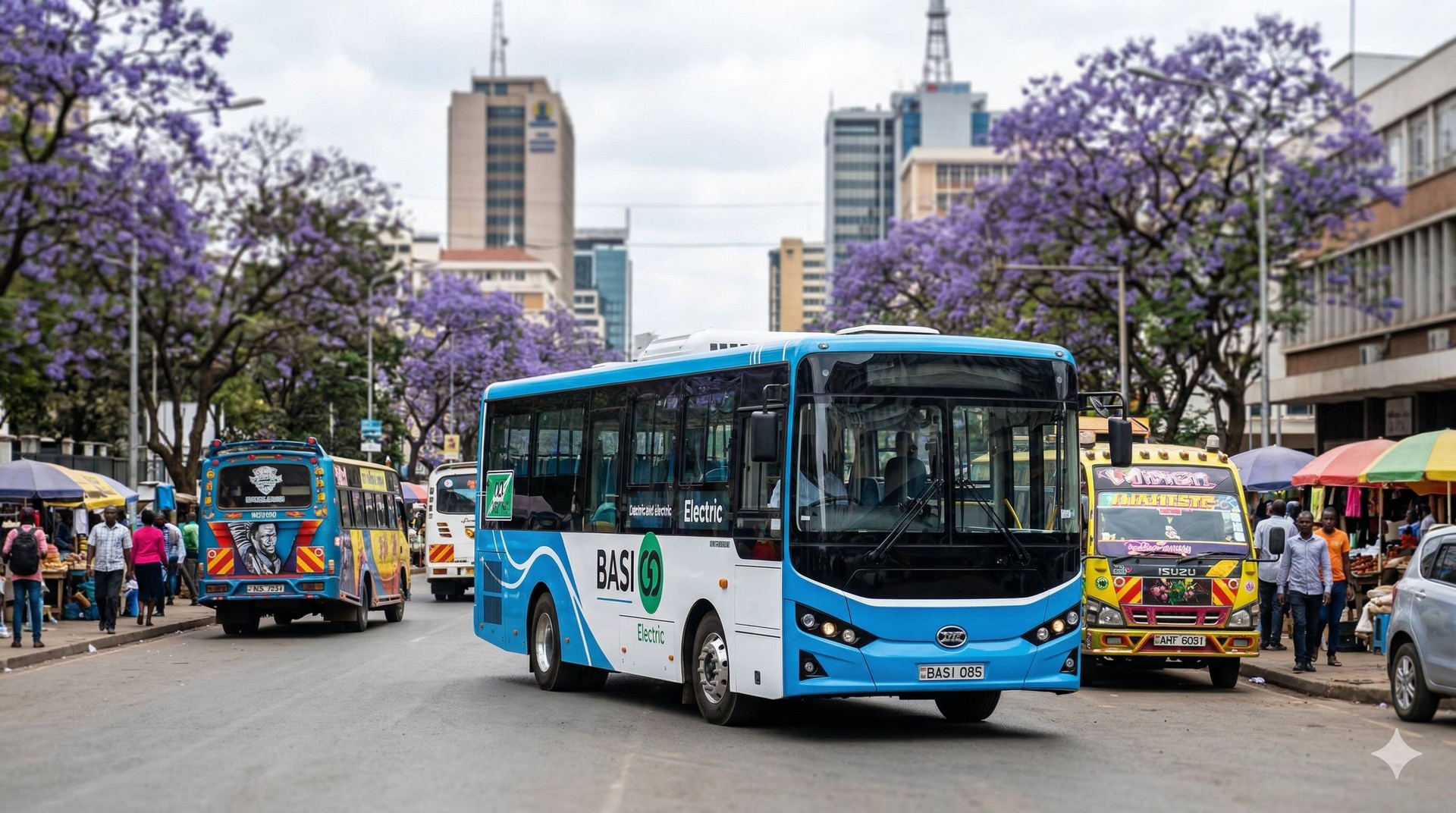
BasiGo's experience with intercity routes illustrates this exactly. Their E9 Kubwa electric bus costs around $58,000 and runs 250 to 300 kilometres per charge. For urban Nairobi, where routes are predictable and depots are close, that works. When they began piloting intercity services, the charging infrastructure simply was not there to support it.
According to Semafor, BasiGo currently operates 11 charging stations, 10 of them inside the Nairobi metropolitan area. That is not a national network, but a city network at best, trying to become one.
The grid is both the advantage and the problem
Something most people miss about the Kenyan grid is the fact that roughly 85 to 90% of Kenya's electricity generation comes from renewable sources. That means an EV charged on the Kenyan grid is genuinely low-carbon in a way that an EV charged from a coal-heavy grid in parts of Asia or South Africa is not. This is a real strategic advantage that Kenya has not fully leveraged in its climate positioning or its pitch to international green finance.
Even so, it's also worth noting that clean generation and reliable, accessible energy are two different things. Some of the remote construction sites we worked on sit outside the reliable grid entirely, or on grid connections that cannot handle industrial charging loads.
Off-grid solar-plus-battery charging is gaining traction, and the technical case for pairing photovoltaics with EV charging is compelling. But the capital to build that infrastructure is where the logic chain breaks down for most small and mid-sized operators. The VAT exemptions exist. The affordable credit to act on them, for operators who are not BasiGo and do not have institutional investors, largely does not.
UNEP data frames the urgency here. The global transport sector contributes around 14% of total greenhouse gas emissions, and those emissions are projected to double by 2050, driven largely by growth in low- and middle-income countries. Africa's cities are growing faster than almost anywhere else on earth. If the transport systems those cities build now are diesel-dependent, locking that infrastructure in for decades, the emissions math becomes very difficult to reverse later.
Where the real opportunity is
Buses and freight dominate the policy conversation. The actual opportunity, right now, is motorcycles.
In Kenya, motorcycles make up just over 50% of the national vehicle fleet, and in 2024, 7.1% of new motorcycle registrations were electric, according to data from the Kenya National Bureau of Statistics and the Electric Mobility Association of Kenya. That share is small, but it is moving. UNEP data puts Africa's total two- and three-wheeler fleet at roughly 27 million vehicles, over 90% of them running on petrol. Motorcycle taxis carry a huge share of last-mile passenger and freight movement across the continent.
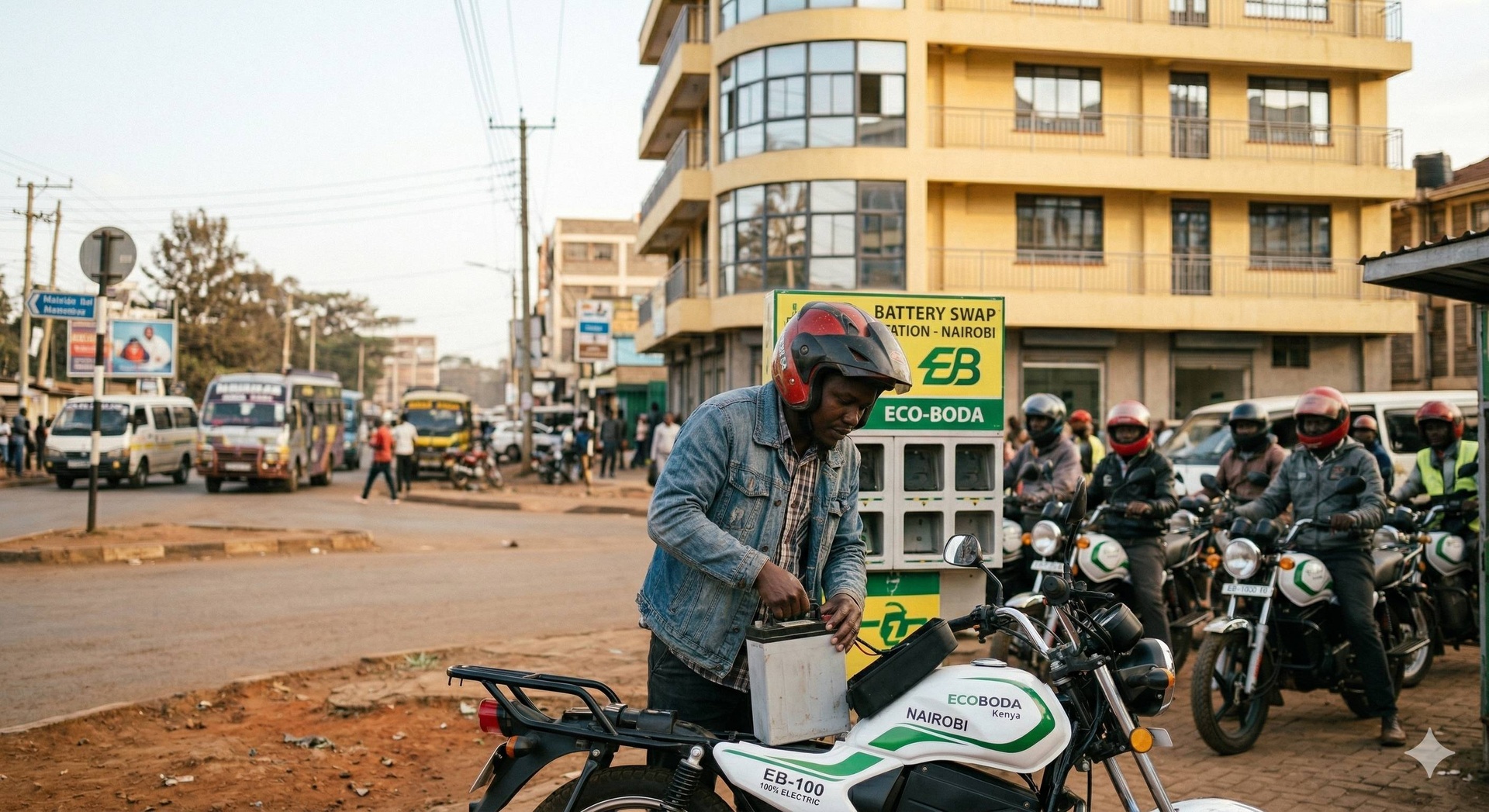
Electrifying this segment does not require building a national fast-charging network or overhauling grid infrastructure. It requires financing, affordable hardware, and service density. Those are hard problems, but they are tractable in ways that commercial freight electrification is not yet.
Battery-swapping models, deployed by companies like Spiro, Arc Ride, and Roam across East Africa, sidestep the charging infrastructure problem entirely. A rider does not wait for a charge. They swap a depleted battery for a full one at a kiosk in under two minutes. For anyone who has watched boda boda operators lose working hours to petrol queues during fuel shortages, the operational logic is obvious.
That’s where the real scale is. Not in the shiny bus depots.
Dakar's all-electric BRT system, launched in early 2024, shows a different end of the scale. 18.3 kilometers of segregated corridor, 144 articulated electric buses, projected to carry 300,000 passengers daily. It is expensive, it required years of political commitment to pull off, and it is proof that government-led public transport electrification works when the infrastructure and the fleet are treated as a single investment rather than sequential problems.
A policy environment that still has work to do
I remember watching the 2024 finance bill circulate. For a few weeks, I reckon every operator must have been on the phone with their accountant, trying to figure out whether the bike they’d budgeted for was suddenly going to cost 16% more. The industry pushed back hard, and the 2025 bill eventually restored the exemptions.
Good. That was the right outcome.
But the fact that the question was even on the table after years of building this enabling environment tells you how fragile it all still is. You can’t ask operators to make five‑year capital decisions on incentives that might vanish in the next budget cycle.

The national target of 5% of all new vehicle registrations being electric by 2027 is achievable in motorcycles. However, it is a significant stretch in buses, and a much longer-term project in heavy commercial vehicles.
The target would mean more if it were broken down by segment, with segment-specific infrastructure commitments attached. That kind of specificity is what actually moves operators from interest to action.
Thinking about this in segments
The most useful thing I took from years on the operational side of fleet management is that there is no single electric transition. There are several, each with its own economics, infrastructure requirements, and timelines. Urban bus routes with predictable distances, established depot infrastructure, and institutional operators are a fundamentally different problem from remote freight. Electric motorcycles for last-mile delivery are a different problem from concrete pumps and excavators on infrastructure sites.
The African countries making the most progress are the ones that have picked a segment, built a workable model for that segment, and scaled it before trying to solve everything at once. Rwanda's push on electric motorcycles. Dakar's BRT. BasiGo's disciplined focus on Nairobi before attempting to go national. None of these are complete answers to the continent's transport emissions challenge. But they make a good case of what becomes possible when policy, financing, and operational reality are actually designed to work together.
The transition won’t be linear, and it won’t look the same in Nairobi as it does in Dakar or Kigali. From where I sat as an operator, the question isn’t “if” anymore. It’s already on the spreadsheet for the next vehicle purchase.
Whether the answer comes back yes depends less on the technology than on the policy, financing, and infrastructure wrapped around it. Get those right, and operators move. Leave them uncertain, and they wait. Right now, most of them are still waiting.